
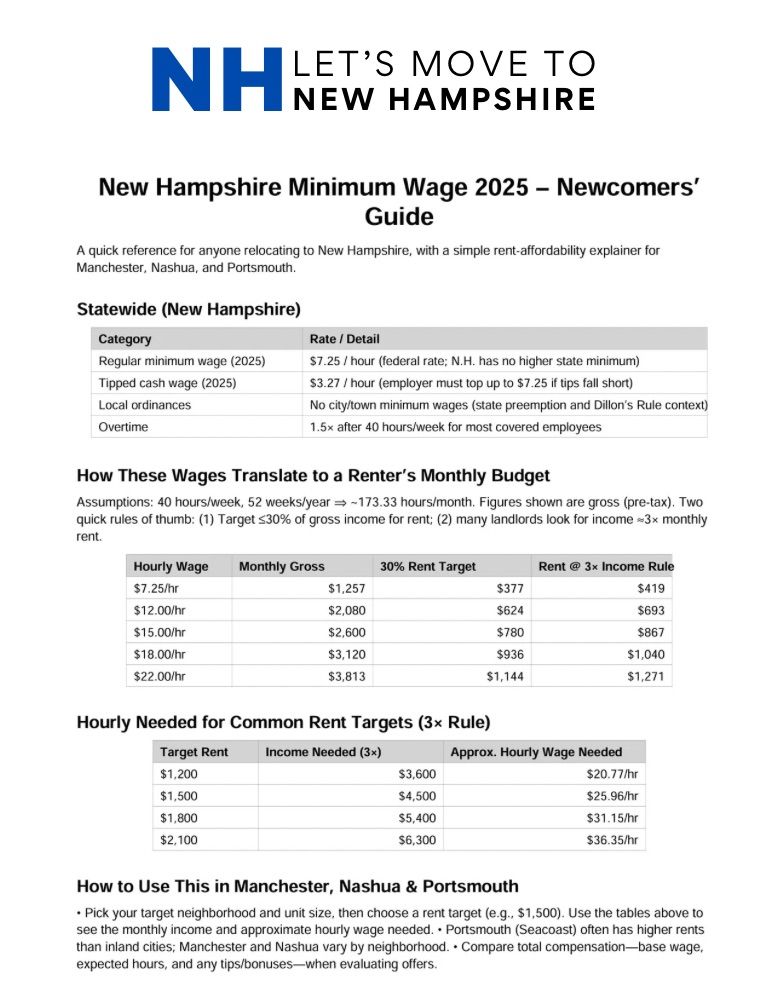
If you’re moving to New Hampshire for work in 2025, here’s the pay-floor reality on Day 1: the state follows the federal minimum wage of $7.25 per hour, with no higher local city or town wageanywhere in the state. For service workers who earn tips, the minimum cash wage is $3.27 per hour(roughly 45% of the regular minimum), and employers must ensure that cash pay plus tips reaches at least $7.25 each pay period.
Statewide rules at a glance
- Minimum wage: $7.25/hour (follows federal rate).
- Tipped cash wage: $3.27/hour, with a maximum tip credit of $3.98; if tips don’t bring you to $7.25, the employer must make up the difference.
- Overtime: Time-and-a-half after 40 hours/week for most covered employees.
No local add-ons (and no hazard-pay mandate)
Unlike some New England cities, New Hampshire has no municipal minimum wage ordinances; pay floors are set at the state/federal level. More broadly, N.H. is a Dillon’s Rule state, meaning local authority is limited unless the legislature says otherwise—one reason you don’t see city-by-city wage floors here. There’s also no statewide hazard-pay requirement during emergencies.
How N.H. compares in New England
New Hampshire is the only New England state still at the federal $7.25; neighbors like Maine, Massachusetts, and Vermont set higher floors. That’s useful context when comparing job offers across state lines or remote roles headquartered nearby.